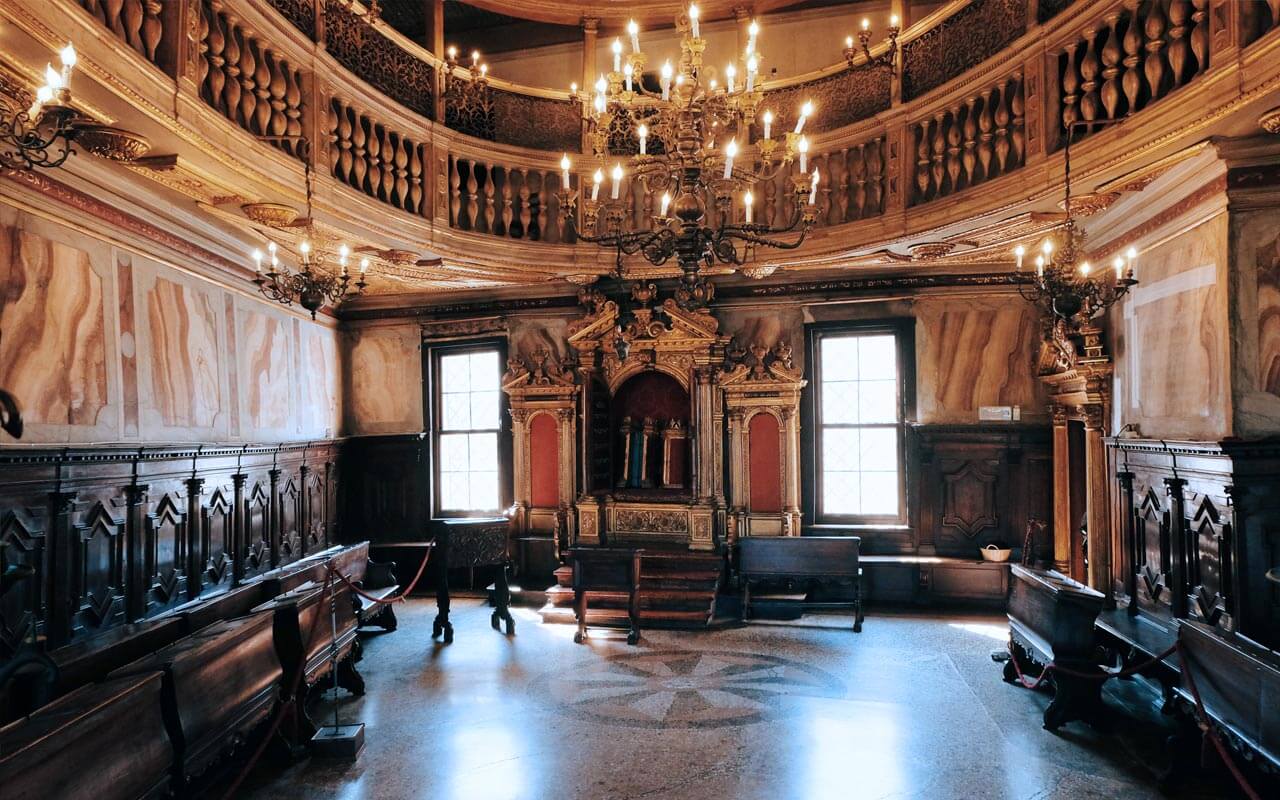
Venezia da Vivere’s journey into Jewish art and culture continues with the Synagogues of the Jewish Ghetto of Venice
Along with the Jewish Museum, the five synagogues are surprising spaces within buildings that protect them, and are said to be the most beautiful synagogues in Europe because of the richly decorated interior spaces. They still are the gathering places of a whole active community.
The synagogues are the religious places for the Jewish religion. The word itself is the translation of the Jewish word Beit Knesset, “house of assembly”, while the Jewish-Italian custom to refer to the synagogues as a “scola” comes from the Yiddish word šul.
The synagogues, or “Scole”, were firstly built in Venice between 1500 and 1600 by the different ethnic groups who were living in the Ghetto: the Great German Scola, the Canton Scola, the Italian, Levantine and Spanish Scolas were then born. Although they underwent some further restoration, they survived time and still testify the value of the Venice Ghetto. Let’s discover them together.
The Great German Scola
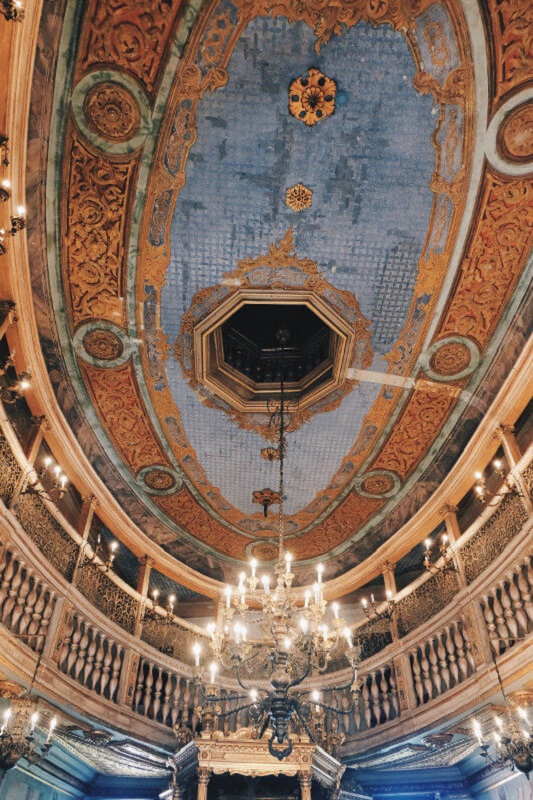
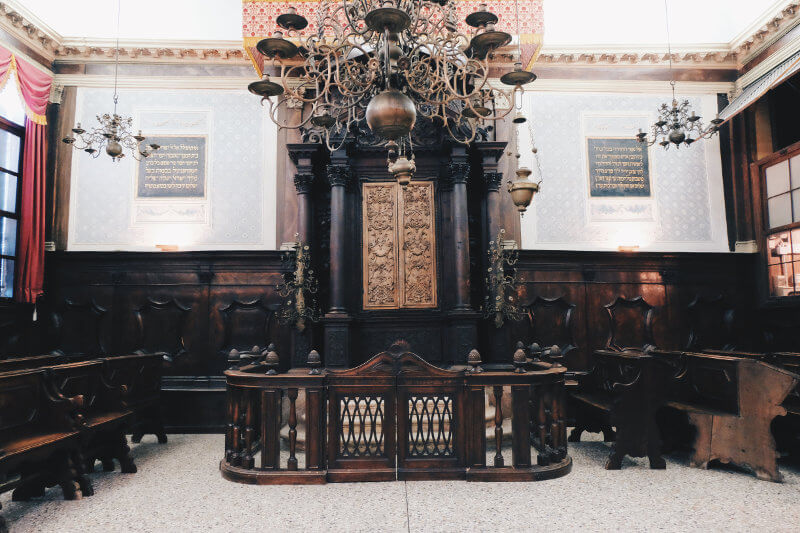
The Great Germas Scola, of Ashkenazi rite, is the first synagogue to be built in the Ghetto. It used to have a central plant with the Bimah at the centre of the prayer room. It was lately moved in front of the Aròn Ha Qòdesh, the sacred closet containing the Sefer Torah, the scrolls of the law.
The irregular plant of the Great German Scola is made harmonical by an elliptic women’s gallery on the upper floor, by the decoration of the walls covered with marmorino and by an inscription, the Ten Commandments, in golden letters on a red background all over the walls of the religious area.
The Canton Scola
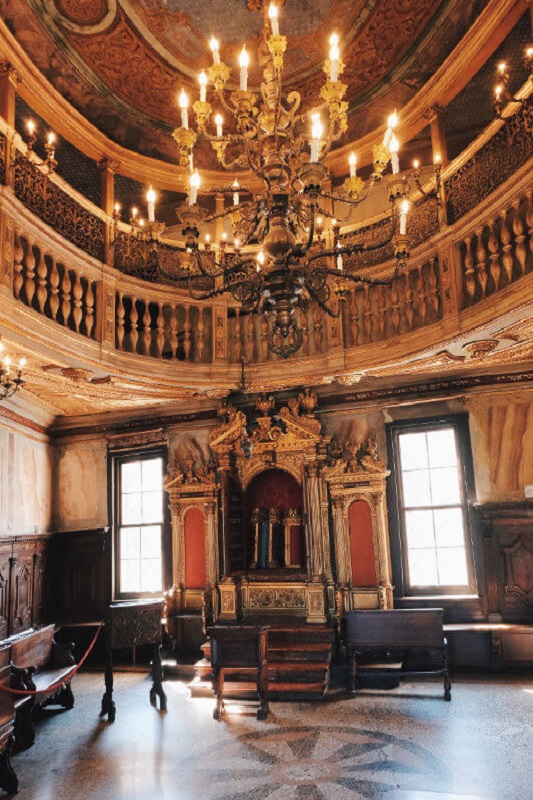
The Canton Scola, founded in 1531/32, has a Baroque and Rococo aspect due to some XVIII century structural interventions. The Canton Scola is characterized by a rare example of figurative art with eight wooden panels representing biblical episodes, like Moses crossing the Red Sea, the manna, the arrival of Ark of the Covenant on the Jordan river, the gift of Torah.
The Italian Scola
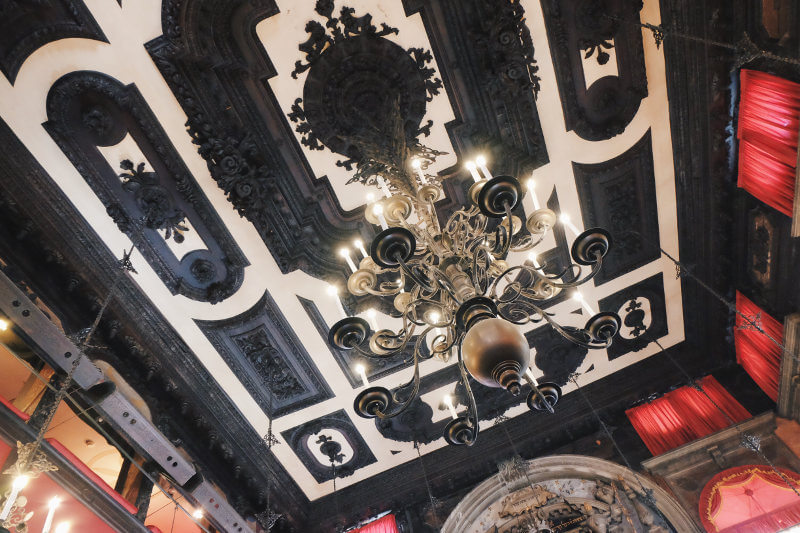
The Italian Scola is the simplest of the Venetian synagogues, but it is very luminous because of the five wide windows facing campo del Ghetto. Built in 1575, this synagogue does not have the gleaming tones of the golden leaf that you can see inside the other synagogues. Thus it has an austere look that is reflected in the whole atmosphere. Also the Italian Scola has a bifocal structure and the Aròn Ha Qòdesh and the Bimah dominate the place: the latter, especially, is in a high position, and give the whole quadrangular-plant place an elegant sobriety.
The Levantin Scola
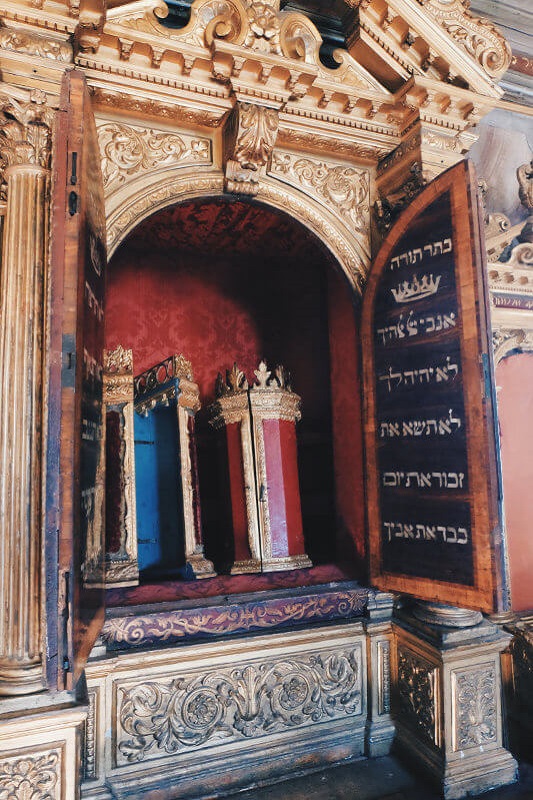
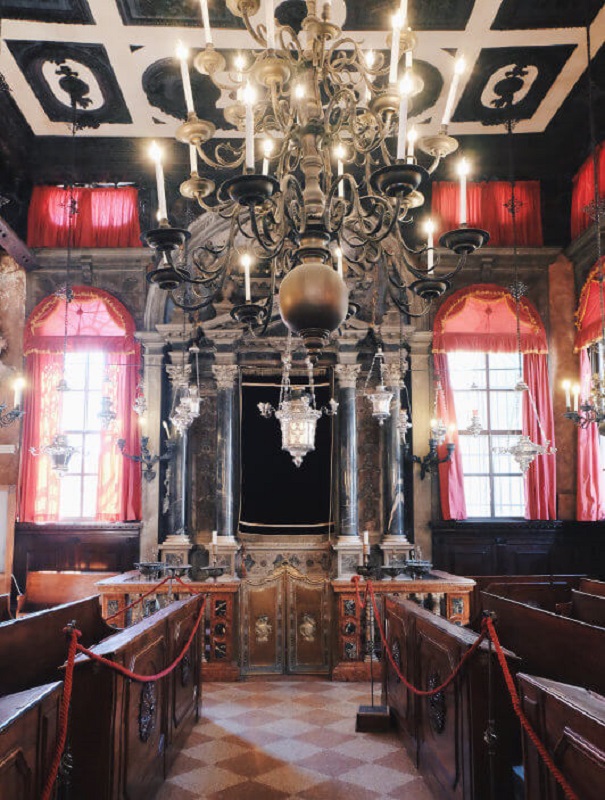
Although we do not have documents to testify it, the Levantine Scola underwent many architectural interventions by the Baldassarre Longhena entourage, whose style is visible in the facade and in the important Bimah by Andrea Brustolon.
Probably founded in the early XVI century, the synagogue of the Levantine Scola was rebuilt in the late XVII century, afterward the Aròn Ha Qòdesh and the Bimah were put in opposit position: the sacred closet is decorated with polychrome marble, sumptuous and Oriental-like, is in the XVII century style and dominates the whole religious area.
The Spanish Scola
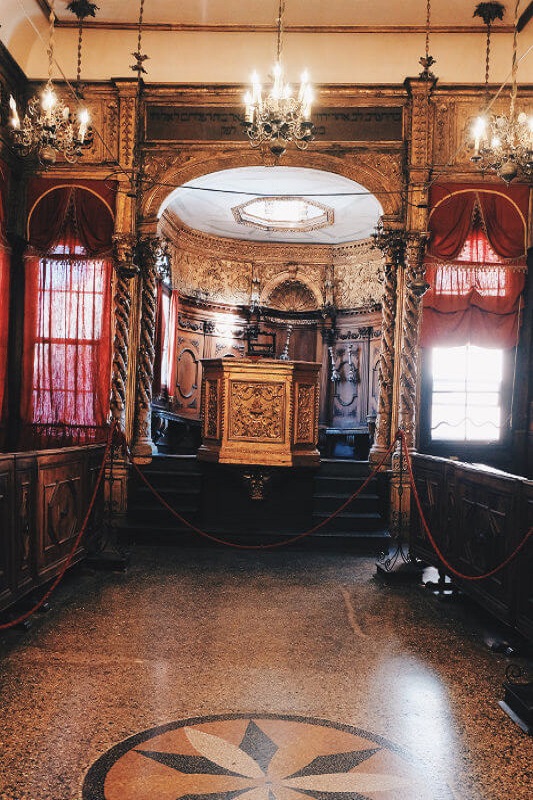
The Spanish Scola is the biggest of the Venetian Synagogues, founded in the late XVI century. Of great scenographic impact, the synagogue has a wide double staircase leading to a wide prayer room which houses an ellptic women’ gallery.
With a bifocal plant, the stylistic grace reveals the touch of an important architect probably belonging to the Longhena entourage, whose style is also visible in the elegant design of the Aron Ha Qòdesh imade of polychrome marble.
All photographs by Riccardo Rizzetto for Venezia da Vivere
The synagogues of the Jewish Ghetto of Venice
Cannaregio 2902/b
30121, Venezia
Tel. (+39) 041 715359
http://www.museoebraico.it/
prenotazioni.mev@coopculture.it
Opening days and hours: the Museum, the synagogues and the cemetery are closed on Saturdays and during Jewish festivities, on 25 December, 1 January and 1 May.
From 1 June until 30 September the Museum opens from 10.00 am until 7.00 pm; from 1 October until 31 May from 10.00 am until 6.00 pm.
Visits to the synagogues and to the Jewish cemetery
The three synagogues open to the public offers guided tours in Italian or in English every hour from 10.30 am; you can also book private tours in German, Spanish, French and Hebrew. The last tour on Fridays might be cancelled due to religious reasons.
Guided tour are aslo possible at the cemetery every week except for the days written above. Booking required.
Synagogues and Museum tickets
Tickets for a visti to the synagogues starting from the Museum: adults 10 euros; concession 8 euros; Venice Card holders 7 euros.
Ticket for a visit to the Museum: adults 4 euros; concession 3 euros.
Private tours
private guided tours to 3 synagogues
Booking requires, private guide, one-hour-long tour; individual visit to the museum without guide.
Euros 90 + single tickets.
special guided tour to 4 synagogues
Booking required, with private guide, 1.30-hour-long tour; con guida personale, durata 1,30 h circa; individual visit to the museum without guide.
Euro 130 +single tickets.
special guided tour to 3 synagogues + guided tour to the museum
Booking required, with private guide, 1.30-hour-long tour; 2-hour-long tour
Euro 150 + single tickets
special guided tour to 4 synagogues + guided tour to the museum
Booking required, with private guide, 1.30-hour-long tour; 2-hour-long tour
Euro 170 + single tickets
Tickets for the Jewish cemetery
Booking required, the guided tour to the cemetery costs 90 euros per group + single tickets

