
A Venice of artisans and thinkers, which to be culturally alive and active relates to “know-how”. Craftsmanship is excellence and a virtuous example to be re-evaluated and promoted. Raffaele Dessì for #RiscrivereilFuturo of Venice.
With the rebirth of Venetian craftsmanship and the training of young people who know how to both explain and produce high-quality crafts, a new residential policy will be created, born from the need to live in the city where one works. By investing in the only possible future—that of the Venetians who live in and maintain the city—Venice will return to being a place to live in rather than to rent out.
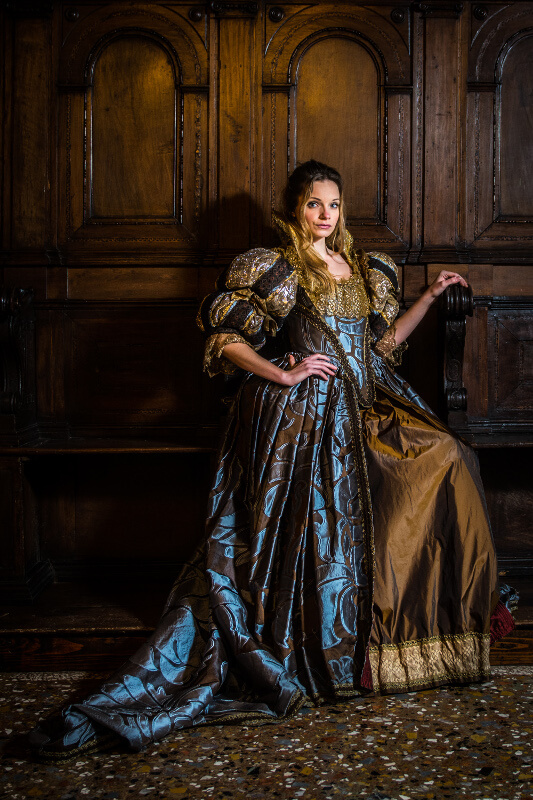
Today we present Raffaele Dessì, architect, expert in the history of costume, and head of events and public relations for Atelier Pietro Longhi in Venice.
VDV: How do you imagine Venice in the future?
The Venice of the future will be more similar in essence than ever to what made it great. Venice is a city of connections; it is a virtual city in its being almost physically impossible, and it is a city that cannot produce something but can only rework materials produced elsewhere. In this lies the greatness of Venice, in its having always been the enormous portal of excellence, and to this we should return.
What is re-elaborated, but also simply sold, in this city must be synonymous with excellence. There should be a sort of aegis over everything found in this city, guaranteeing quality by the mere fact of having “passed through Venice.”
This happened with spices and fabrics, with the quality of glass, marmorino plaster, and gilding. Venice was an artisan city that, by working with excellent raw materials, created excellence envied and therefore purchased everywhere. And this excellence passed through a publishing industry free to circulate ideas, necessary perhaps today more than yesterday, to make us aware of what it means to be able to choose and to be capable of doing so. Therefore, the Venice I imagine is one of artisans and thinkers, free to create beauty and ideas that return to being the greatest Venetian wealth.
VDV: What can politics and citizens do for a rebirth of Venice?
Politics and citizens should coincide, and all citizens should take care of their polis. I believe, therefore, that politicians should start administering public affairs as if the citizens were an integral part of the system. Artisans who produce quality should have spaces—workshops, warehouses, and sales spaces—at controlled prices.
The artisan should be supported by various figures, especially by those who deal with the training of young people. Two types of schools should develop around a workshop.
Vocational schools, which train young artisans without this cost falling on the professionals. I am thinking of glassmakers or weavers, knowing full well that years pass before a young person can actually produce. This is usually addressed by the artisan, who takes it upon themselves by training a relative to whom the business is left.
Cultural schools to train young people who understand artisanal quality and see it as a wealth to be promoted. This can happen by studying not only Venetian culture but also that of the country where the product will be offered. A painted ceramic from Bassano, rather than a soprarizzo velvet, or a “Rezzonico” chandelier, changes its way of being presented depending on the country in which it is sold, as the perception of the artifact itself is different.
The study of foreign languages and economies for certain school curricula should be aimed at understanding how to best propose Venetian material culture so that it can be understood by the foreign buyer. And this applies both when the object is exported and sold abroad, and when it is offered in city shops.
For this reason, the city itself could take care of creating a sort of large “Fondaco of Quality” where only certified objects are sold, with employees who know as much about artisanal objects as they do about the culture of those interested in purchasing.
The artisan could periodically go to the workshop/fondaco to meet end users, but sellers should also periodically go to the workshops so as not to lose contact with the production phase, which is fundamental for understanding and communicating the soul of the artifact.
This project also requires support for the supply chain: the same facilities for small shops selling everyday objects in the historic center, where the artisan can find everything necessary at affordable prices.
Stationery shops, household goods stores, and hardware stores would become necessary again in a city repopulated with artisans and their families, as well as sellers, and all this segment of the population would turn to local bars and restaurants, which would no longer live on tourism alone.
For Venice to be born again, I believe it will be necessary for citizens and politics to coincide once more, with everyone committing themselves, in the way each deems appropriate, to the formation of a true resident community that makes the city itself real and alive.
VDV: Propose a specific idea in at least one of these areas: environment, residency, work, culture, security, tourism.
Culture to understand the city. Culture, like politics, should be common to all citizens, and everyone should be put in a position to enjoy it to understand the city in relation to their own abilities and interests.
Museums as simple aseptic containers are now outdated: works travel both virtually and physically, so now more than ever, it would be necessary to rethink museums that recreate environments and life where the works were born, restoring their soul and creating the difference that justifies a visit compared to copies and virtual displays.
Works should be illustrated by explaining their revolutionary capacity and the reason why they deserve hours of observation. Historic workshops that are repositories of artisanal knowledge must be considered on the same level as museums: great jewelers rather than weavers, fashion houses, lace and glass bead producers are not simply shops, but true workshops in the Renaissance sense of the term where art and culture are created and sold.
It should be almost natural to organize guided tours inside artisan workshops, or to complete the realistic displays of museums with unique artisanal pieces that are proudly shown as contemporary art in the sense of being produced today. In this way, the museum would become a living environment where conservation and quality production could coexist.
To remunerate artisans for the loan of their works, one could think of actual rentals for exhibition, which would give meaning to the quality production of their artifacts intended for the community, not just for their own shop windows. This is what happened with the great treasures and collections of the past, when the Patron par excellence, the State, financed the production of works to show the productive capabilities of its artists and artisans.
In order not to merely archive and preserve an artisanal capacity capable of creating art, culture must pass through know-how.
Raffaele Dessì, Atelier Pietro Longhi.
Read all interviews

How do you imagine Venice in the future?
Read all interviews on:
www.veneziadavivere.com
www.associazionepiazzasanmarco.it
Facebook @sanmarcopiazza
Facebook @veneziadavivereofficial
Instagram @veneziadavivere
Instagram @sanmarcopiazza

