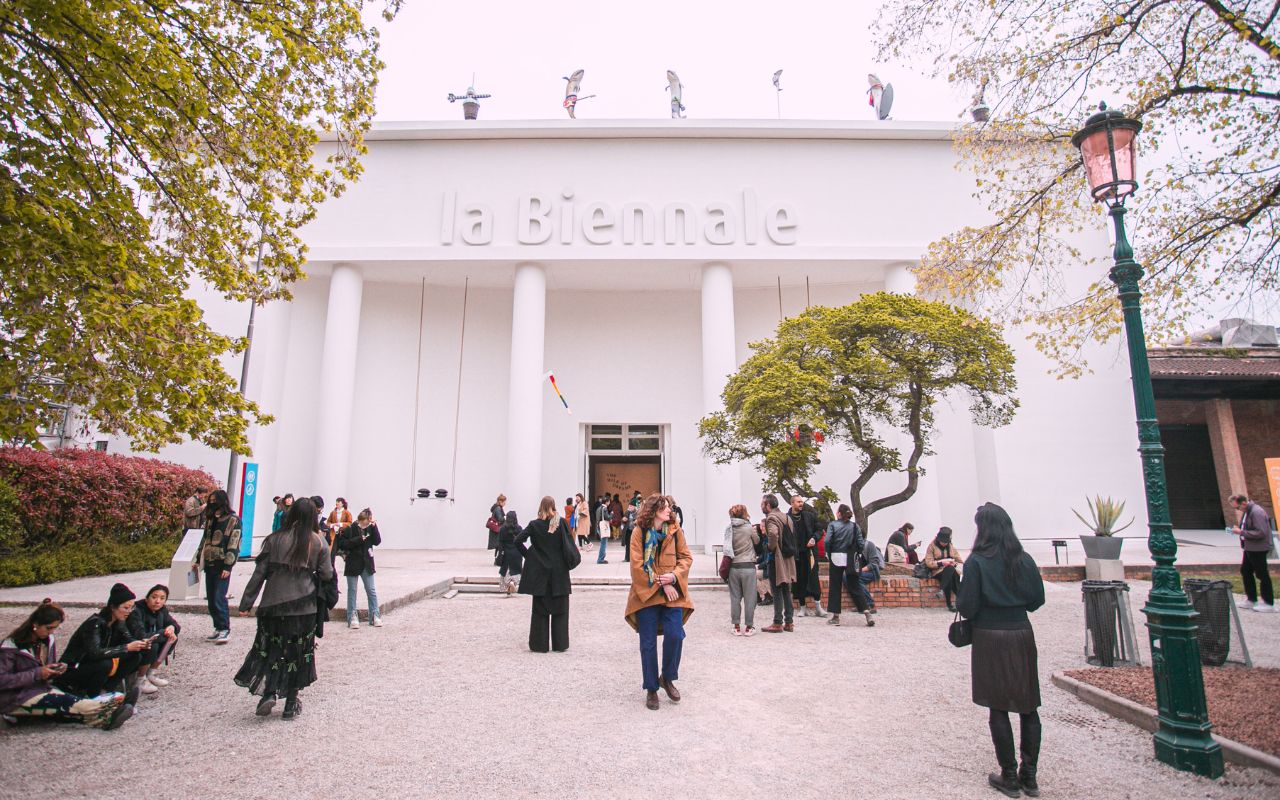
New and essential: the Central Pavilion of the Venice Biennale is ready for the opening of the 2026 Art Biennale
The Biennale will once again have its Central Pavilion, transformed by a “re-invention,” as architects Maria Claudia Clemente and Francesco Isidori of Labics have called it: the first comprehensive redevelopment in 131 years.
“It was simultaneously a project of preserving the memory of the place and of radical rewriting.” Maria Claudia Clemente


The Central Pavilion after construction: what changes?
The interventions at the Central Pavilion have redesigned the internal and external circuit we were accustomed to. Some changes were necessary: Carlo Scarpa’s fixtures restored and relocated, the Brenno del Giudice Hall redesigned according to the forms of the 1928 project, the layers of interventions accumulated over time finally eliminated. Others were definitive, such as the disappearance of Tobias Rehberger’s colorful, secluded, and almost impossible-to-find bar.
It was a spacious and disorienting space: bright white, black lines, colorful geometric elements inspired by the razzle-dazzle painting of World War I. The wow effect was guaranteed. Rushes to the electrical outlets, a refuge from sudden rains, the bar in 2009 won the Golden Lion at the 53rd Art Biennale. Now there is a new café with windows overlooking the canal and external wooden terraces inspired by Venetian architecture.


2026 Art Biennale: In Minor Keys and the legacy of Koyo Kouoh
At the opening of the 2026 Art Biennale – preview from May 5 to 8 and official opening from May 9 to November 22 – we will see a fundamental piece of the Biennale in its new format. It is here that in each edition projects and works that translate the curatorial concept into physical space are concentrated.
Koyo Kouoh, the Senegalese-Cameroonian curator and director of the Iziko South African National Gallery in Cape Town, passed away before presenting the completed work. In May we will see the fruits of her legacy thanks to the team that Koyo had personally chosen and who are carrying forward the exhibition in her spirit: advisors Gabe Beckhurst Feijoo, London-based art historian, Marie Hélène Pereira, Berlin-based curator, and Rasha Salti, programmer and curator between Beirut and Berlin; Siddhartha Mitter, New York-based journalist, in the role of editor-in-chief, and Rory Tsapayi as research assistant.
The theme chosen by the curator is In Minor Keys, that is, the minor key in music: the one that brings emotions to the surface without forcing them, that expresses without shouting. And it is consistent with what the Pavilion itself conveys upon reopening: the interventions are profound, and they do not impose themselves. The new photovoltaic glass skylights bring uniform natural light without you seeing them; the systems are completely hidden behind walls and roofing; the exhibition halls are neutral spaces free from any obstruction. Discretion is a design choice.
Like a treasure chest that preserves what is valuable without flaunting it, somewhat set back from the perimeter of the Central Pavilion and from the main exhibition route, there is one of the many jewels of Carlo Scarpa in Venice: the Sculpture Garden, with its meditative path among majestic ivy, concrete canopies, and water basins that Scarpa had conceived as a silent extension of the exhibition space. In the redevelopment project, Scarpa’s original fixtures were carefully restored and relocated.
There is something strange and beautiful about entering a space you know by heart and finding it different, like when you enter a new house, with that smell of freshly dried paint, where you already feel at ease. Because this is where it all began.


Cover photo: Central Pavilion Biennale ph. Marta Formentello.
Photos of the Central Pavilion (press opening) and Tobias Rehberger’s bar ph. Irene Fanizza.
Article by Lucia Pecoraro.

