
Daily life means establishing the principles to strengthen oneself and become a city that is Master of its own home. Marco Toso Borella for #RiscrivereIlFuturo
We continue with the debate for the rebirth of Venice and with new interviews for #RiscrivereIlFuturo, the project curated by Venezia da Vivere and the Associazione Piazza San Marco. W e have the pleasure of presenting the Muranese artist Marco Toso Borella: a glass painter following ancient family traditions, a writer, historical researcher, and director of Italy’s largest choir, the Big Vocal Orchestra and the Vocal Skyline, with over 300 members.
VDV: How do you imagine Venice in the future?
The system has collapsed. The cardinal points of the past no longer exist; they have unraveled. Therefore, it is useless, if not harmful, to attempt to restore them at all costs “as they were and where they were” in a short time. It would be like fighting to keep butcher shops open in a world where everyone has suddenly become vegetarian.
Venice must not return to being the Venice it was until two months ago, but the Venice it was until two centuries ago—that is, a different planet on Earth, a universe unto itself that has changed the course of history over the centuries. I am not a revanchist, nor a deluded person wishing for the return of the Serenissima or candles instead of light bulbs. Instead, I believe we must recover the innate essence of this city, its role as a protagonist in world history.
Venice arose when the Roman Empire collapsed, creating an oasis of divergence from the surrounding world which was crossed by dozens of invasions over the centuries: it made remote islands habitable, drove millions of piles to erect palaces and houses, diverted and channeled rivers to preserve its lagoon, and built artificial barriers to defend itself from the sea. It did everything to prevent the surrounding world from “infecting” it in the minds and bodies of its inhabitants. And it did so, paradoxically, without ever closing its doors, even in times of war.
Venice was an open port for people, art, and culture, but every “alien” had to reckon with it, had to stand before it with respect, even with awe. Venice became an alibi, etymologically speaking—an “elsewhere.” And it can still be so, starting precisely from its greatest wealth: Art. But not a contemplative art, rather a generative art.
Venice cannot be considered a relic; it must be a vital monument. A monument actively traversed by its inhabitants, who must be the blood that flows, pulsing, every day. Inhabitants who must be both memory and future.
We must reiterate every day that it is the future that must change, not the city. Because when the future does not change, it becomes Futurism, and then people want to pave over the canals to let “automobiles” flow, as Marinetti hoped. When the future becomes Futurism, oil tanker channels are dredged, chemical plants are set up a short distance from St. Mark’s Basilica, and ocean liners are allowed to pass in front of the Doge’s Palace, in front of the most delicate city in the world: it is like bringing elephants into a crystal shop. When the future becomes foul, it is transformed into the present. VENEZIA is transformed into #@venice, a desperate maîtresse who until yesterday could not find enough paid lovers for the endless passing caravans and who today weeps for the unexpected time of “chastisement.”
VDV: What can politics and citizens do for a rebirth of Venice?
Politics is the citizen. The citizen is politics. The mouth and the rest of the body are part of the same organism. The mouth is the instrument through which the body manifests and declares its intentions. The mouth procures sustenance for the body. Not vice versa.
Problems exist because the mouth (politics) is no longer the instrument of the body (the citizen), but vice versa. Today, the citizen is only filling their mouth, without it distributing what it receives for the benefit of the organism of which it is a part (the city, the State).
Politics and citizens are hypnotizing each other, thinking only about how to return to how they were before, after a high-speed viral train overwhelmed them along with what seemed like certainties. For a rebirth of Venice, the citizen must remember to be a politician, and the politician must not forget that they are the voice of the citizen.
Venice must become the House that deals the cards, not the green felt table upon which dice and chips are thrown by those who have bought the House. One cannot experience Venice from one’s own home, and even less can one transform Venice into one’s own home. Increasingly, people talk about Venice without knowing it; virtual knowledge is fueled without conveying the real sense of things.
Enough with dressing the city up like an old harlot to offer her to the magnate of the moment, who rents the Doge’s Palace for millions for his silicone-filled receptions.
Enough with talking about new frontiers, brands, supply chains… Formats repeated to the point of boredom by “industry specialists” capable only of writing “Venice” or the name of anything else on the blank lines of their pre-printed arguments from years ago: for them, every subject is the same, everything is interchangeable, even unique pieces.
If anyone can tell me of an artistic phenomenon, the name of an artist, or an idea that has emerged from Venice in the recent editions of the endless Biennales we are forced to witness, I would be grateful.
Events and phenomena disconnected from the city and its inhabitants, useful only to create visibility and new contacts for the many curators/prophets and their protégés, who transform Venice into a dazed frame for pseudo-artistic installations visited only by the guests of the opening mega-party.
I ask: was Venice known before its Film Festival? I’ll venture a yes. And Cannes? Was it known before its Festival? But they have the films we don’t like, the ones that make a profit, while in our elite Festival, we have the genesis of auteur filming with Dr. Spock’s filter on the Zeiss lens. Only to then see photographers wagging their tails waiting for a taxi at the Hotel Excelsior with the American heartthrob of the moment, the star of the only commercial film hosted. But we are Venice… Enough with the Arsenale transformed into a detached parlor hosting things that cannot even be defined.
It is sad to say, but the emperor has no clothes. He never did. We simply need to tell the doctor who brought the patient Venice to this state that he cannot be the one to get her out. Here, someone has stepped into the gold-rimmed plate that is the city without even taking off the hobnailed boots of the designer of the moment.
VDV: Propose a specific idea in at least one of these areas: environment, residency, work, culture, security, tourism.
Why? Are we planning the famous Plan B while hoping with all our hearts for an immediate restoration of the old Plan A? The Aztecs waited for the return of Quetzalcoatl, the Feathered Serpent, to be able to worship him again. And their entire existence was aimed at welcoming him in the best possible way.
The question is, in reality: “Do you wish to format the Venice hard drive to improve its performance?” Because that is what needs to be done, not managing the interim. I too am waiting, then, seated on the shore, for our Quetzalcoatl to return again—perhaps on an ocean liner—bringing the gifts of Paradise to all the residents of “Venessia,” hoping that the Feathered Serpent is not actually, as it was for the Aztecs, Hernán Cortés.
A single lever to raise the entire city: the Venetian citizen-politician must remember the uniqueness of their place of origin. It must be Venice that regulates the guest’s behavior, making them a participant in its specificity, and not vice versa. Let us start with the Venetians, with the daily needs of those who live and reside in this city; let us start with art, craftsmanship, and the productivity that this city can still express, and only then, in a second stage, think about welcoming the “alien.”
And let us ensure that it is the tourist who adapts to our rituals, pays for their own transport, and waits in line at the piers, just to give a concrete example. Why is it that in Venice, and only in Venice, are citizens told that it is the guest who pays for what rightfully belongs to the master of the house?
Public services for “permanent citizens” are—everywhere in the world—part of a city’s “fixed costs,” and must therefore exist regardless of the “surplus” of those who come to visit it, who must pay separately for what they need. The tourist is a “variable citizen” and must necessarily be a “variable cost” for the city. Let us ensure that Venice is no longer just the city everyone dreams of visiting but, on the contrary, becomes the city everyone dreams of living in. This is true sustainable tourism. Returning to the metaphor of the opening: I feel for those who insist on being butchers in a world that has become vegetarian.
And this is coming from a carnivore.
Marco Toso Borella, Muranese artist.
Read all the interviews
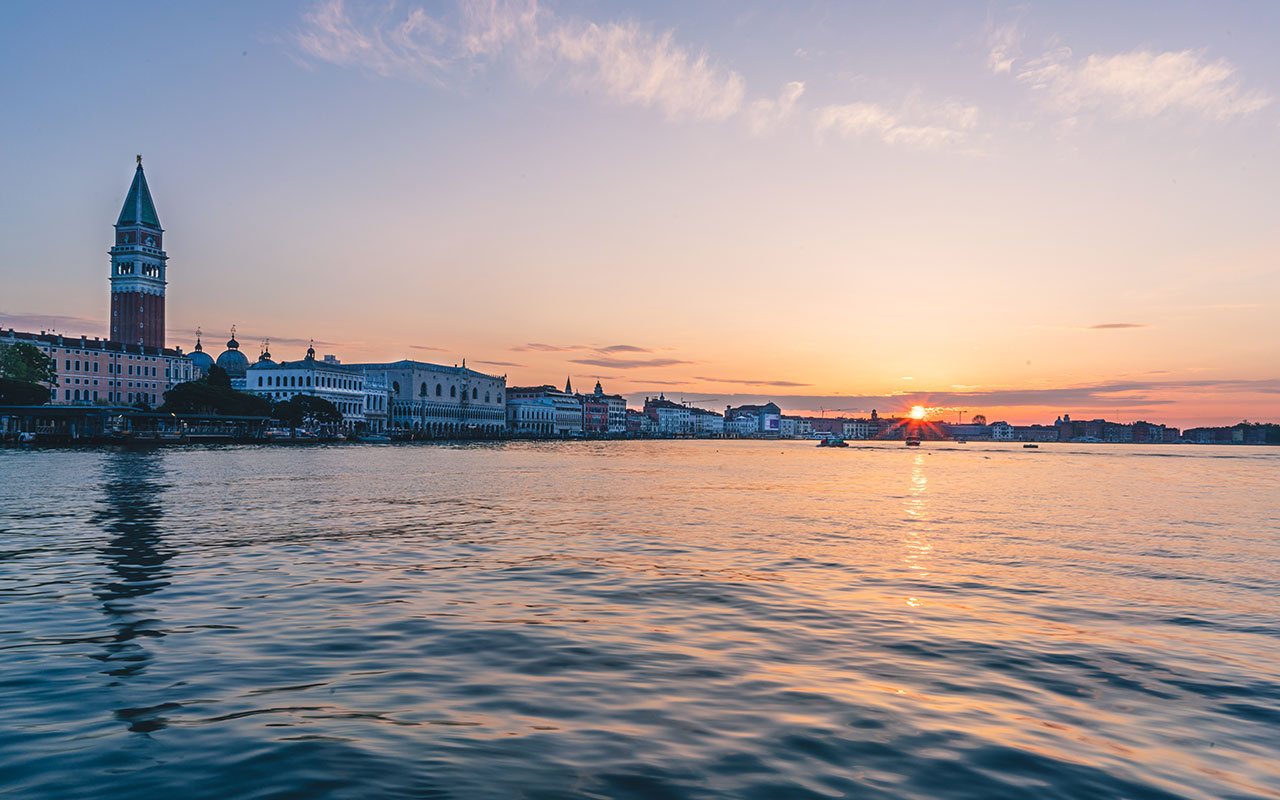
Cover photo by Dave Krugman.
How do you imagine Venice in the future?
Read all the interviews on:
www.veneziadavivere.com
www.associazionepiazzasanmarco.it
Facebook @sanmarcopiazza
Facebook @veneziadavivereofficial
Instagram @veneziadavivere
Instagram @sanmarcopiazza

