The Venice of Carlo Scarpa: an itinerary through the works of the great architect and his artisans: the Olivetti Shop, the Querini Stampalia, the Biennale
The Venice of Carlo Scarpa is a continuous discovery of his mastery: craftsmen and carpenters, stones, metals, marbles and boiserie tell the story of how it was to work with the Maestro, his delicate references to history, his irony in designing, his love for the different materials
I met him when I was a child, and I remember that he was drawing some design elements with a pen on the tablecloths of the Ristorante da Cici and that he was discussing with my father the preparation’s details for the Biennale pavilions.
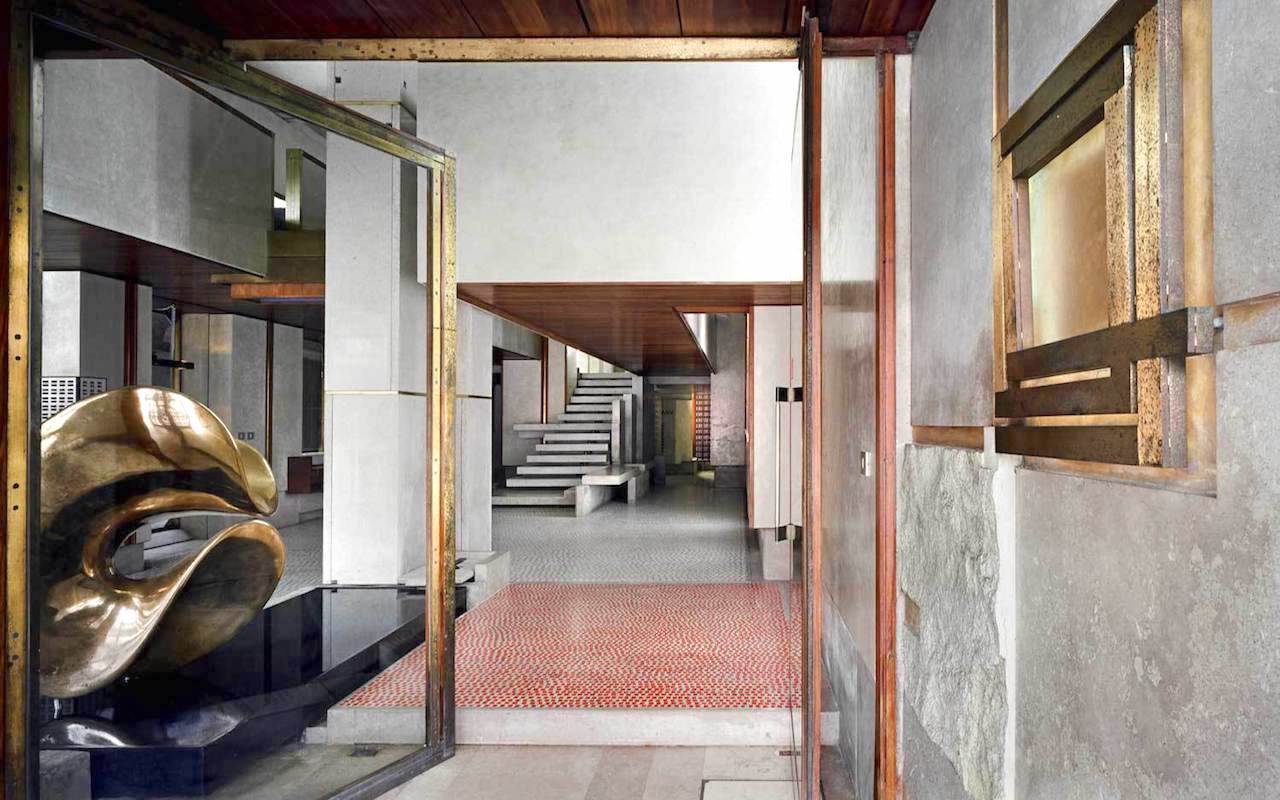
Water, wood, marble, stone, iron, mosaic and Murano glass. Water and light become elements in Carlo Scarpa’s work and this can be seen at the Monument to the Partisan in front of the Biennale Gardens by following the stream of water that enters free during high tide in the spaces of Querini Stampalia in Santa Maria Formosa. The light draws the spaces of the Olivetti Shop in Piazza San Marco when it enters from the Olivetti logo brass frieze next to the door, reverberates on the perfectly smooth water of the fountain at the entrance and on the mosaics floor and plays with the full and empty volumes of the staircase.
This Thursday, November 28 at 18:30 a special guided tour leads us to discover the details and secrets of this place emblematic of the excellence of Italian design and technique, symbol of Scarpa’s architecture
The visit to the Olivetti Shop is the beginning of an itinerary to discover Carlo Scarpa through a hidden and at times unprecedented Venice. Let’s explore together the Baratto Hall at Ca ‘Foscari, the Iuav ai Tolentini, the Querini Stampalia, and some structures of the Biennale.
An itinerary to explore the tucked-away corners of Venice thanks to the work of the Venetian architect.
The Universities: Cà Foscari…
Aula Baratto – Barter Hall
Inside the headquarters of Ca ‘Foscari is the Baratto Hall, an interesting example of modernity in a historic Venetian palace: the restoration of the Hall is one of the most interesting work by Carlo Scarpa, a masterpiece created in collaboration with some Venetian artisan shops; this is one of the most specific examples of the architect’s modus operandi.
Scarpa was involved in the design of this space on two occasions: in 1935-37 to use the space on the second floor as the Aula Magna and in 1955-56 to transform the barter hall into a lecture hall and to create the wood panelling.
The wooden frame of the polifora is the most important work of Scarpa’s first works, while the window, divided into two sections, presents sliding windows in its lower part. The wooden platform, on which the Chair is placed, is composed of walnut wooden blocks.
In 1956 the wood panelling was introduced, a wooden and glass structure that separates the hall from the external corridor: the simplicity of the 30s style windows leads to a more complex architecture and the use of new diagonal shapes such as Y shaped crutches that support the ceiling of the wood panelling itself.
San Sebastiano
Designed by Scarpa in 1978, the entrance gate to the former convent of San Sebastiano is an example of dialectical comparison between buildings and surfaces belonging to different eras.
The entrance to the building, which houses the faculty of Letters and Philosophy Ca’ Foscari, consists of an L-shaped Istria stone frame, with scaling and cut-out crown mouldings; while in the upper margin it has a circular shape to accommodate the fifteenth-century statue of San Sebastiano.
… and the IUAV
You can find a posthumous project by the architect at the Tolentini, by the entrance to the IUAV headquarters, the Venetian university directed by Scarpa in the late 1970s.
The new arrangement of the entrance presents a completely new concept: the ancient arched portal was disassembled, placed horizontally inside the structure itself and used as a basin. In its place there is now an iron gate sliding on wheels, on which an Istrian stone slab is anchored.
In the year of the celebration for its 90th anniversary, in 2016 the IUAV hosted the Carlo Scarpa Exhibition, by Carlo Scarpa, a tribute to the Venetian architect. The exhibition showcases unpublished testimonies of Scarpa’s vast activity including sketches, drawings, reproductions and photographs.
The Querini Stampalia Foundation
The Querini Stampalia Foundation was founded in 1869 by the will of Count Giovanni Querini Stampalia, the last descendant of the noble Venetian family. In his will, Giovanni imagines a place open to comparison, a place of knowledge, of the encounter between cultures, of personal growth and of the expansion of knowledge through personal development and training.
It is a unique example of a structure where ancient rooms are side by side to contemporary architecture work; it is here that Scarpa perhaps reaches his highest peak in his research.
The atrium, for example, is a unique case of coexistence between water and concrete materials: the Venetian architect, organizing passages and tunnels to let water enter the building, gives this element dignity and importance and it becomes an integral part of the space. In the splendid garden there is a large multi-level tank in copper, cement and mosaics and a small canal, at the end of which there are two small labyrinths in alabaster and Istrian stone.
The Biennale
In his career Carlo Scarpa focused with sensitivity and empathy on the setting up of exhibitions and museums, revolutionizing the concept of museum exhibitions. The Venice Biennale can boast a long and prestigious series of his installations and work, started in 1948 and concluded in 1972.
Scarpa’s works for the Biennale are of particular interest as they range between different styles and methods of conception and realization, combining the analysis of contemporary architecture with the specificity of the Venetian environment as well as reflecting the architect’s own artistic growth.
The exhibitions of 1948 for the Guggenheim collection and the personal exhibition by Paul Klee were temporary. In 1952 the architect planned and realised the entrance to the exhibition site and the Giardino delle Sculture (Garden of the Sculptures), an exhibition space inside the Italian Pavilion, where water tanks, planters and pedestals made of bricks create a poetic and collected internal landscape.
The famous Venezuelan Pavilion, built in concrete and glass, is characterized by long angular windows that allow an efficient and at the same time delicate entrance of the light into the building.
A few steps away from the entrance to the Biennale Gardens you can find the Monument to the Partisan, which commemorates the women who participated in the liberation from the Nazi-fascism.
From the edge of the Riva dei Giardini, thanks to a clever interruption in the brick parapet, visitors can enter the area of the monument, to which Scarpa contributed by creating the tessellated basement and a no longer-existing iron-cement floating box that allowed the dramatic sculpture of a fallen and dying woman, realised by Augusto Murer in 1961, to float on the water.
For more information on the Biennale and Scarpa’s works for this establishment you can consult the website of the Venice Biennale.
The Olivetti Shop
One last hidden gem to discover and explore is the Olivetti Shop, a two-story space in Piazza San Marco under the arcades of the Procuratie Vecchie. After losing its original function for many years, in 2011 the shop was reopened after a careful restoration of the FAI, which returned the colours, the furnishings and the original Olivetti machinery collection.
In 1957 the setting up of the shop was commissioned to Scarpa by Adriano Olivetti, who had taken over the disused premises of a former shop in the Piazza. Among the different Piedmontese entrepreneur’s projects, the shop in Venice was meant to become a prestigious exhibition and launching point for Olivetti’s innovative office items, in order to attract the attention of customers as well as that of artists and intellectuals.
Carlo Scarpa reorganized the store in a volumetrically joined environment with the first floor almost entirely lofted. In this large room there is a staircase, modelled with lateral displacements, through which you can reach the first floor, one and a half time bigger than the lower one, and an elegant ornamental fountain in white marble and copper. A sculpture by the artist Alberto Viani, one of the most significant artists of the Italian twentieth century, seems to float on the water.
All rooms are paved with marble and Murano glass: a series of quadrangular tiles, of different colours in each area, are interspersed with finishes in white and smooth stone, with a glossy effect that plays with the different intensity of lights present in the shop: the colours of the floor get brighter and brighter as you move away from the windows.
With the Olivetti store Scarpa has created a project of great formal and material refinement, developing an essential architectural style but also refined and eclectic, in which elements like water, wood, glass and marble find their most complete expression.
The Olivetti Shop is a property managed by the Italian Environmental Fund FAI and can be visited by booking a tour at www.negoziolivetti.it.
Carlo Scarpa’s artisans
A last suggestion to appreciate the work of Carlo Scarpa regarding the world of Venetian craftsmanship is to pay a visit to the Carpentry Capovilla and the Officina Zanon, two historical artisan workshops still in activities, which have collaborated for years with Scarpa in the supply of raw materials and in the processing and assembly of his works.
The ‘Time and Details’ initiative. Artists / Artisans / Carlo Scarpa, curated by Chiara Bertola and Geraldine Bias, collected the works of 14 international artists called to compare their work to the architecture of Carlo Scarpa: specifically, the Zanon workshop hosted a site-specific project by Remo Salvadori while the Capovilla carpentry workshop hosted a work by Alice Cattaneo.
Laura Scarpa
The photos of Ca ‘Foscari are by Riccardo Rizzetto, @riccardorizz, while those of the Querini Stampalia Foundation are by Marco Valmarana, @marcovalmarana, for Venezia da Vivere. The remaining images have been kindly granted by IAUV, Biennale di Venezia and Fai – Olivetti Store.
Carlo Scarpa in Venice
Università Ca’ Foscari: Aula Baratto
Dorsoduro 3246
Tel. +39 041 234 8111 / 8323
urp@unive.it
www.unive.it
Ca’ Foscari: San Sebastiano
Dorsoduro 1686, Campo San Sebastiano
Tel. +39 041 2347356
Iuav
Santa Croce, 191, Tolentini
Tel. +39 041 2571819
comesta@iuav.it
www.iuav.it
Fondazione Querini Stampalia
Castello 5252, Santa Maria Formosa
Tel. +39 041 2711411
fondazione@querinistampalia.org
www.querinistampalia.org
La Biennale di Venezia
Castello, Campo Monte Grappa
Tel. +39 041 5218711
info@labiennale.org
www.labiennale.org
La Biennale di Venezia
Castello, Campo Monte Grappa
Tel. +39 041 5218711
info@labiennale.org
www.labiennale.org
Negozio Olivetti
San Marco 101, Piazza San Marco
Tel. +39 041 5228387
fainegoziolivetti@fondoambiente.it
www.negoziolivetti.it
FAI members: € 2.00
Full price: € 10.00
Reduced ticket (children 4-14 years) and students up to 26 years: € 7.00
Reduced family ticket (2 adults + 2 children): € 24.00
Carpentry Capovilla
Santa Croce 853/A
Tel. +39 041 718835
Officine Zanon
Cannaregio, 3213
Tel +39 041 718060

