
Carlo Scarpa’s Venice: from the FAI Olivetti Store to the Querini Stampalia Foundation, from the Biennale Gardens with the iconic ticket office reopened for the 2025 Architecture Biennale, to the last project in Venice. An itinerary through the works of the great architect who revolutionized museography and design
Carlo Scarpa left Venice a unique testimony of modern architecture perfectly integrated into the city’s fabric. We have created a complete itinerary of Carlo Scarpa’s Venice through his most important public works, starting from the Museo Correr, which hosts until October 19 the exhibition dedicated to his revolutionary installations, continuing to the Olivetti Store designed for Adriano Olivetti in 1957 and preserved by FAI, reaching the Querini Stampalia Foundation, where water enters freely with the tide, transforming into architectural dignity.
At the Biennale Gardens we find: the Sculpture Garden with its distinctive elliptical columns, the Venezuela Pavilion, an example of Venetian brutalism, and the recently restored circular ticket office.
To conclude the tour dedicated to Carlo Scarpa, a gem to discover is the Galerie Negropontes, housed in the Palazzina Masieri, one of the houses designed by Carlo Scarpa for private clients, visitable thanks to Sophie Negropontes, who chose to open a Venice location of her Parisian gallery here. Come with us.
Scarpa’s Museographic Laboratory
Display cases, showcases, and the painting easel that revolutionized Italian museography are featured at the Museo Correr with Il Correr di Carlo Scarpa 1953-1960, the exhibition that until October 19 documents, through period photographs and original pieces of Scarpian design, how the Venetian architect forever changed the art of display.
Scarpa first intervenes in the Venetian History rooms on the first floor of the Procuratie Nuove, designing showcases for senators’ robes and panels for Ottoman shields from the Morean Wars (1684-1699), then completely redesigns the Picture Gallery on the second floor, where natural light from the balconies overlooking Piazza San Marco guides the arrangement of paintings and sculptures.
Small dedicated rooms enhance masterpieces such as Cosmè Tura’s Pietà and Carpaccio’s Two Venetian Ladies, while Antonello da Messina’s Dead Christ Supported by Angels finds space in a small room completely clad in travertine, where the orientation of the cladding and the inclination of the painting play with natural light and masterfully enhance chiaroscuro and details.


The Showroom That Revolutionized Design
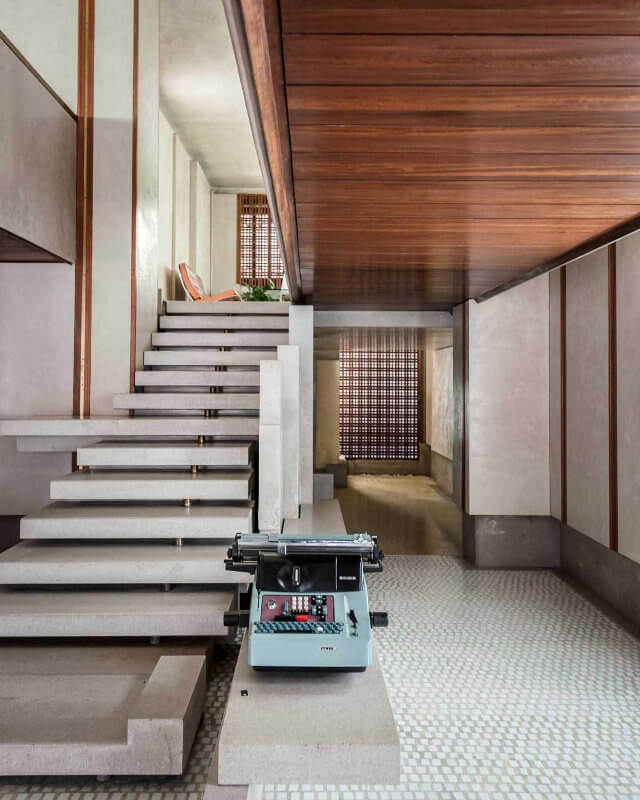
The exhibition becomes the starting point for an itinerary through Carlo Scarpa’s Venice. Commissioned by Adriano Olivetti in 1957 and inaugurated the following year, the Olivetti Store – FAI under the arcades of the Procuratie Vecchie preserves the original installation.
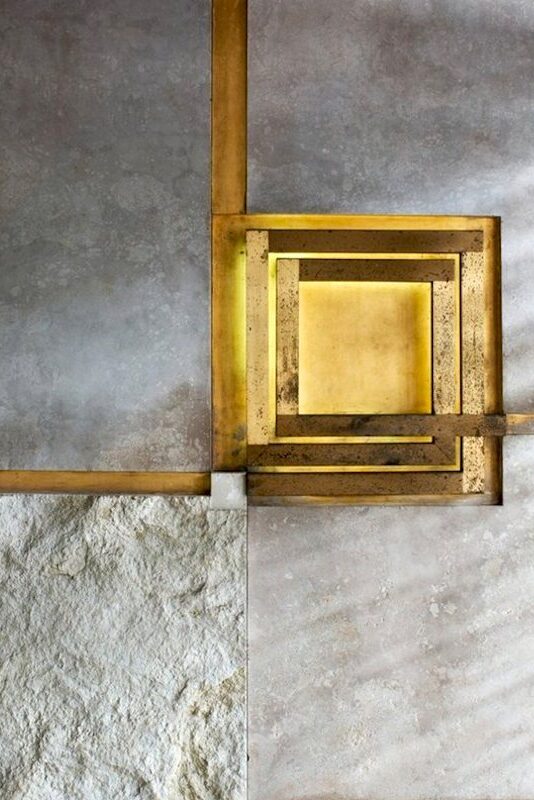
Outside, the brass logo is set into a white marble slab that introduces the space through large windows and Istrian stone slabs.
Inside, the gilded bronze sculpture Nude in the Sun by Alberto Viani is displayed on a black marble base, framed by Murano glass mosaics and details in rosewood and stainless steel. A monolithic staircase with staggered steps, equipped with an African teak gallery, leads to the mezzanine floor, where calibrated openings frame views of Piazza San Marco and provide a backdrop for historic Olivetti machines.
When Water Becomes Architecture
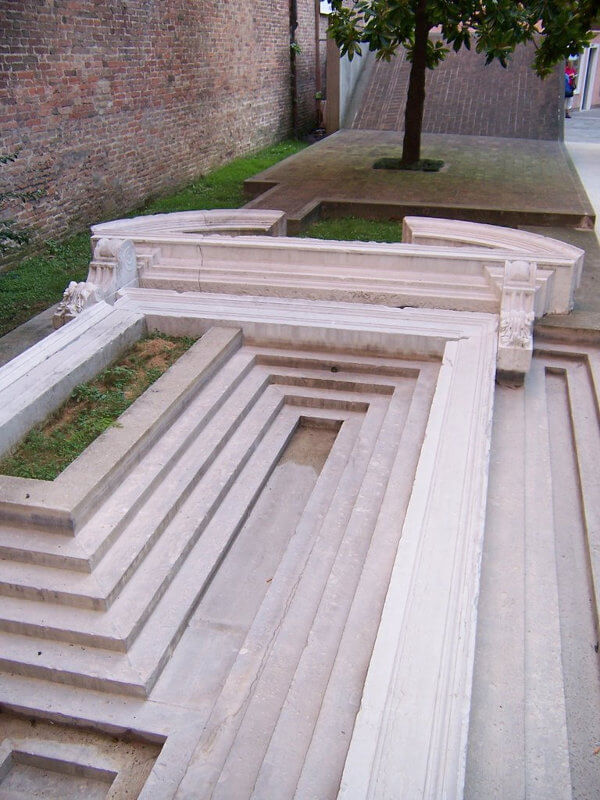
The Querini Stampalia Foundation at Santa Maria Formosa perhaps represents the highest peak of Scarpian research in Venice. An intervention from 1959-1963 where water enters freely with the tide through passages and tunnels designed by the architect, transforming the liquid element into architectural dignity, while in the garden a multi-level basin in copper, concrete, and mosaic dialogues with small labyrinths in alabaster and Istrian stone.


Scarpa at the University
The Baratto Hall and the San Sebastiano Portal for Ca’ Foscari
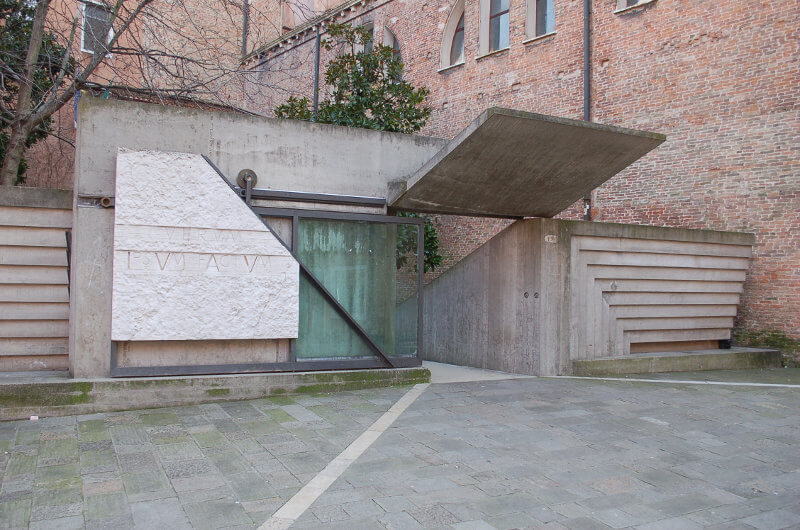
At Ca’ Foscari University of Venice, the venue for numerous conferences is the Baratto Hall with its wood and glass paneling from 1956 and the characteristic Y-shaped brackets that support the ceiling, while the San Sebastiano portal features an L-shaped Istrian stone frame with a sliding portal in iron, bronze, and stone that leaves visible the ancient shrine with the fifteenth-century statue of San Sebastiano.
The Transformation of the Tolentini Portal at IUAV University
At Tolentini, the entrance to the main campus of IUAV University of Venice, a project completed by architect Sergio Los in 1984, shows how Scarpa’s design transformed the ancient arched portal, discovered during the restoration of the Tolentini convent, into a horizontal basin, replacing it with a sliding gate anchored to an Istrian stone slab.


Scarpa’s Architectures That Steal the Scene at the Biennale Gardens
The Sculpture Garden
In the former Italian Pavilion, now the Central Pavilion (currently under restoration), Carlo Scarpa transforms a courtyard into a space between rigor and delicacy. Three elliptical concrete columns support a perforated canopy, where circles subtracted from a rectangle become portals of light that draw moving shadows on the ground. Hidden planters, water and basins, brick seating, and details that invite pause, without breaking the exhibition rhythm.
The Venezuela Pavilion: Venetian Brutalism
Built between 1954 and 1956, the space for Venezuelan representation arose from an international impulse entrusted to Scarpa as a play of shifted volumes, a mix of exposed reinforced concrete, glass, and details of great character: the external surfaces tell of raw material, the internal ones tend toward white and chromatic plays.
The Scarpa Ticket Office
Designed between 1951 and 1952, the Scarpa Ticket Office (on the cover – photo by Melania Dalle Grave, DSL Studio) welcomed visitors at the entrance to the Gardens: a circular enclosure in glass, concrete, and wood, balanced on an almond-shaped canopy, supported by wood-clad uprights.
Now restored for the 2025 Architecture Biennale by architect and activist Giulia Foscari and her dual agency UNA-UNLESS with support from Cassina, it hosts Voice of Commons, a program of meetings, talks, and podcasts on Global Heritage of Humanity – Antarctica, the Ocean, the Atmosphere, and Space: the Planetary Embassy, which has the patronage of UNESCO, the UN Decade of Ocean Science for Sustainable Development, and the European Space Agency.
The Monument to the Partisan Woman
Along the Riva dei Giardini, Scarpa created the site that houses a monument of strong symbolic value: the bronze sculpture by Augusto Murer depicting a fallen partisan woman, lying prostrate on the waters.
The work was created in 1961 after a neo-fascist attack on July 27, 1961 destroyed the previous monument in polychrome ceramic by Leoncillo Leonardi, inaugurated in 1957.
Carlo Scarpa designed the base for both works: first for Leonardi’s and then for Murer’s, imagining that the most appropriate way to observe the work was from above, placing the organic body of the sculpture below the visual line of the pavement on concrete caissons embraced by Istrian stone.
Few know that this is a place where one can sit and meditate, watching the city’s waters lap against the sculpture.


The Palazzina Masieri, One of the Last Marvels
The Palazzina Masieri, restored and opened to the public in March 2024 thanks to the collaboration between IUAV University and Galerie Negropontes, represents Carlo Scarpa’s last significant intervention in Venice: a project entrusted to the architect in 1968, approved in 1972, completed in 1983, after his death. On the facade, burnished brass inserts define openings and windows, while the bronze handrail dialogues with the exposed concrete structure of the internal staircase, characterized by staggered steps that optimize the space between the two levels.
The Galerie Negropontes hosts until November 22, as part of the 19th Architecture Biennale, the exhibition Architectural Landscapes, in which site-specific installations by Gianluca Pacchioni, Pinton and Perrin & Perrin are inserted into Scarpa’s spaces: bronze sculptures that echo the brass details of the facade, velvet tapestries arranged on lime-treated walls, and glass positioned to exploit the light filtered through the large “clock glass” windows.
From Friday, September 5, for the Venice Design Biennial and The Venice Glass Week, the second floor of the gallery hosts the exhibition Architectural and Design Landscapes with the jewelry collection Myths & Surrealism: zoomorphic sculptural rings by Walid Akkad, collaborations between Éric de Dormael and Agnès Baillon combining light and brass, explorations of fibers and weaving by Ulrika Liljedahl, silver pieces by Jean-Christophe Malaval inspired by mythology and futuristic architecture, dreamlike creations by Elena Syraka that sublimate the Mediterranean mythological heritage. The works of Maison Matisse complete the exhibition path across the three floors of the Palazzina.


Carlo Scarpa in Venice
Museo Correr
Piazza San Marco 52
correr.visitmuve.it
Olivetti Store – FAI
San Marco 101, Piazza San Marco
www.negoziolivetti.it
Querini Stampalia Foundation
Castello 5252, Santa Maria Formosa
www.querinistampalia.org
Ca’ Foscari University of Venice:
Baratto Hall
Dorsoduro 3246
San Sebastiano Portal
Dorsoduro 1686, Campo San Sebastiano
www.unive.it
Portal of the IUAV University Main Campus
Santa Croce, 191, Tolentini
www.iuav.it
La Biennale di Venezia (Gardens)
Scarpa Ticket Office
Venezuela Pavilion
Sculpture Garden (the Central Pavilion is under restoration and therefore the garden is not accessible)
www.labiennale.org
Galerie Negropontes – Masieri Foundation
Palazzina Masieri, Dorsoduro 3900
negropontes-galerie.com
Article by Lucia Pecoraro with Laura Scarpa.
Cover: Scarpa Ticket Office at night at the Venice Biennale, ph. Melania dalle Grave / Artemide.
Photos by: Sculpture Garden, Central Pavilion, La Biennale di Venezia © Marco Valmarana, Song to the Siren, 2022, Video (colour, sound) © Furio Ganz/ Pierre Henri Leman, Gabriele Bortoluzzi for the Masieri Foundation.

